
Stainless Steel Threaded Flanges Weight Chart in KG – Complete Size & Weight Guide
February 17, 2026
Stainless Steel Companion Flanges Weight Chart in KG & MM with PDF Download
February 18, 2026
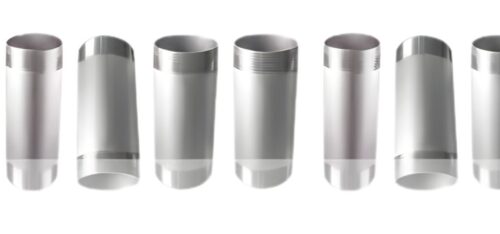
Buttweld Pipe Nipples must be accurately calculated prior to installation since it influences directly upon the structural design, the spacing between the supports of the pipes, transportation planning and the cost of the whole project. Engineers and purchasing departments use the Buttweld pipe nipples weight chart as a tool to work out the right specifications, according to nominal size and wall thickness. When the standardized weight references are utilized, industries can minimize oversizing, minimize material wastages and ensure that the international piping codes are adhered to. The correct weight assessment also enhances the efficiency of installation as well as the safety of its operations in the long run.
The welded connections in the piping systems used in industrial application are essential in ensuring structural stability and leak free services. These elements include among others, short lengths of pipe with beveled ends that are taken to lengthen pipeline or join fittings by butting welding. These parts are fabricated in different materials such as carbon steel, stainless steel and alloy steel to meet various pressure and temperature conditions. They are designed to be fully fused resulting in a strong and permanent joint, which works effectively in a harsh working environment like refineries, power plants, petrochemical plants, and offshore structures.
Carbon Steel Schedule 40 – Weight Chart
Carbon steel Schedule 40 is also commonly used in moderate pressure systems in which both durability and cost-efficiency are a consideration. They are usually used in water distribution lines, oil pipes, structural frameworks, and in general industrial pipes. The thickness of the balanced wall is also good enough to offer the required mechanical strength, and will not contribute undue weight to the system. The ease at which they can be welded renders them easy to install and secure and stable joints all along the pipeline.
Weight Chart – Carbon Steel SCH 40
| Nominal Size (Inch) | OD (mm) | Thickness (mm) | Weight per Meter (kg) |
| ½” | 21.34 | 2.77 | 1.27 |
| ¾” | 26.67 | 2.87 | 1.69 |
| 1” | 33.40 | 3.38 | 2.50 |
| 1½” | 48.30 | 3.68 | 4.05 |
| 2” | 60.33 | 3.91 | 5.44 |
| 3” | 88.90 | 5.49 | 11.29 |
| 4” | 114.30 | 6.02 | 16.07 |
| 6” | 168.28 | 7.11 | 28.26 |
| 8” | 219.08 | 8.18 | 42.55 |
| 10” | 273.05 | 9.27 | 60.29 |
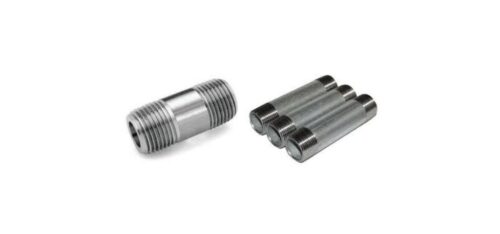
Buttweld Pipe Nipples Weight Chart types are characterized by high tensile strength as well as good weld compatibility. The beveled ends are also fully penetrated to enable welding which creates a joint that evenly spreads the stress on the pipe. These welded connections, when installed properly, will increase structural continuity and will decrease the chances of leakage or discontinuous joints when under pressure.
Key Features
• Beveled ends enabling full penetration welding
• Uniform wall thickness for consistent pressure handling
• Smooth internal bore for improved fluid flow efficiency
• Available in multiple sizes and schedules
• Manufactured as per recognized industrial standards
These components are structurally reliable and dimensionally accurate so that they can fit perfectly into complex piping systems. The fact that they can be used in standard and specialist industrial conditions makes them compatible with different grades of pipes.
Stainless Steel Schedule 80 – Weight Chart
Stainless steel Schedule 80 is chosen in the case of corrosion resistance and increased pressure resistance are required. They are common in chemical facilities, maritime facilities, medicinal manufacturing facilities and food processing plants. The schedule 40 has a thin wall which makes it strong and thus more durable in service conditions that are challenging. Stainless steel like 304 and 316 are resistant to oxidation, moisture and chemical exposure.
Weight Chart – Stainless Steel SCH 80
| Nominal Size (Inch) | OD (mm) | Thickness (mm) | Weight per Meter (kg) |
| ½” | 21.34 | 3.73 | 1.62 |
| ¾” | 26.67 | 3.91 | 2.20 |
| 1” | 33.40 | 4.55 | 3.24 |
| 1½” | 48.30 | 5.08 | 5.41 |
| 2” | 60.33 | 5.54 | 7.48 |
| 3” | 88.90 | 7.62 | 15.27 |
| 4” | 114.30 | 8.56 | 22.32 |
| 6” | 168.28 | 10.97 | 42.56 |
| 8” | 219.08 | 12.70 | 65.78 |
| 10” | 273.05 | 15.09 | 96.15 |
Stainless steel buildings are highly resistant to corrosion and have high durability against corrosion even in wet or chemical hostile environments. The extra thickness of Schedule 80 enhances the ability to bear pressure, which makes it viable in case a system is sensitive in terms of its operations. They have smooth interiors that have constant flow properties and minimize turbulence within process pipelines.
Advantages
• Strong and permanent welded connection
• Enhanced corrosion and oxidation resistance
• Higher pressure handling capacity
• Reduced maintenance requirements
• Suitable for elevated temperature operations
These advantages make them ideal for industries where pipeline failure can lead to safety risks or costly downtime. The welded joint ensures structural integrity and minimizes vibration-related loosening.
Alloy Steel Schedule 160 – Weight Chart
In very harsh conditions like boiler systems, refineries and also high pressure steam lines, the wall thickness must be heavier. Components of Schedule 160 alloy steel are designed to withstand extreme mechanical loads and thermal expansion. Their strong construction contributes to their functioning in conditions when temperature and pressure levels are considerably greater than the ones in the regular industrial systems.
Weight Chart – Alloy Steel SCH 160
| Nominal Size (Inch) | OD (mm) | Thickness (mm) | Weight per Meter (kg) |
| ½” | 21.34 | 4.78 | 1.99 |
| ¾” | 26.67 | 5.56 | 2.85 |
| 1” | 33.40 | 6.35 | 4.25 |
| 1½” | 48.30 | 7.14 | 7.12 |
| 2” | 60.33 | 8.74 | 11.00 |
| 3” | 88.90 | 11.13 | 22.55 |
| 4” | 114.30 | 13.49 | 33.72 |
| 6” | 168.28 | 18.26 | 66.48 |
| 8” | 219.08 | 23.01 | 104.80 |
| 10” | 273.05 | 28.58 | 158.30 |
Components made of alloy steel present a better thermal and strength capability hence suitable for high pressure process systems. The increased weight of their thicker wall should be taken into serious consideration which will be properly calculated by the use of the Buttweld pipe nipples weight chart to design the support and to install the support safely. Operation safety directly depends on structure accuracy and quality of materials in such demanding systems.
Applications
• Oil and gas transmission pipelines
• Petrochemical and refinery processing units
• High-pressure steam and boiler systems
• Offshore and marine structures
• Heavy industrial manufacturing plants
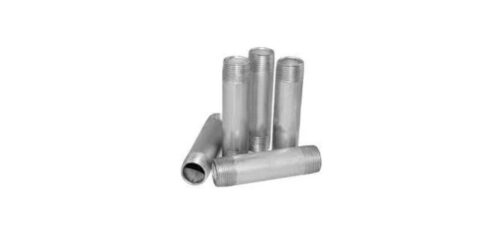
Across these sectors, Buttweld pipe nipples provide secure welded connections capable of withstanding vibration, internal pressure surges, and temperature variations without compromising performance.
Conclusion
The process of safe and efficient piping design requires the choice of the right size, schedule, and material. Buttweld pipe nipples weight chart is a valid source of reference to ascertain the exact weight values to be used in planning structures and making purchases. Buttweld pipe nipples with strong welded joints, resistant to corrosion and high-pressure, with great durability make it a critical component of the industrial infrastructure where durability and safety are paramount.