

Essential Documents for Metal Export Customs Clearance
January 6, 2026
Step-by-Step Guide to Starting a Steel Scrap Export Business from India
January 7, 2026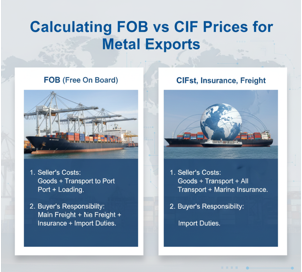
Pricing is one of the most important decisions in international metal trade. Whether you export steel, aluminum, copper, or alloy products, choosing the right pricing method helps avoid confusion, disputes, and losses. Two of the most commonly used pricing terms are FOB and CIF. Understanding how to calculate FOB vs CIF prices for metal exports allows exporters and buyers to make better business decisions.
What Are FOB and CIF in Metal Exports
FOB and CIF are international trade terms defined under Incoterms. They explain who pays for which costs during transportation and where the responsibility transfers from seller to buyer.
FOB (Free On Board)
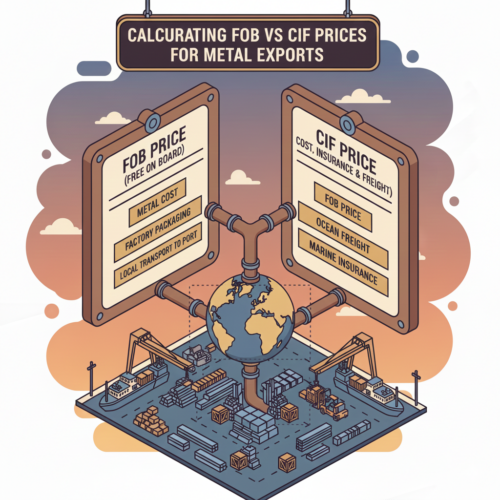
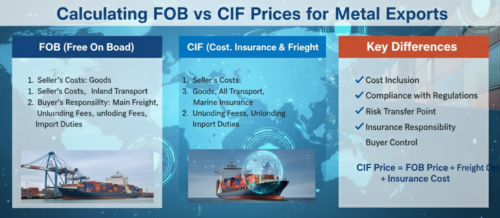
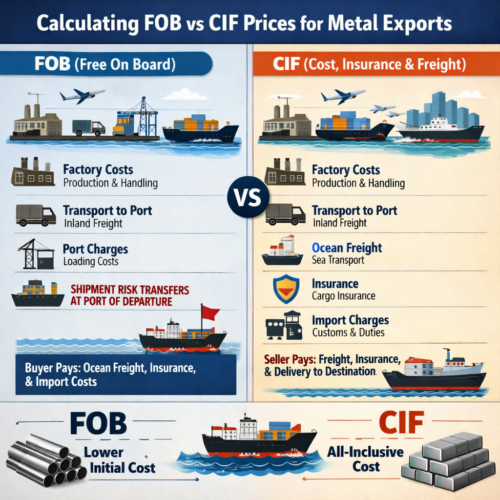
Under FOB, the exporter is responsible for all costs until the metal goods are loaded onto the vessel at the port of shipment. Once the goods are on board, responsibility shifts to the buyer.
CIF (Cost, Insurance, and Freight)
Under CIF, the exporter covers the cost of goods, marine insurance, and freight charges up to the destination port. Risk transfers once goods are loaded, but cost responsibility continues until arrival.
Cost Components in FOB Pricing
FOB pricing includes only the costs incurred up to the loading port. It is commonly used when buyers have strong logistics networks.
FOB price includes:
- Manufacturing cost of metal products
- Raw material and processing cost
- Packing and palletizing
- Inland transportation to port
- Export customs clearance charges
- Port handling and loading charges
- FOB does not include ocean freight or insurance.
Cost Components in CIF Pricing
CIF pricing includes all FOB costs plus additional international shipping expenses. It is often preferred by buyers who want a single, all-inclusive price.
CIF price includes:
- All FOB costs
- Ocean freight charges
- Marine insurance cost
- Destination port delivery (up to port only)
- CIF does not include import duty or inland transport at destination.
Example: FOB vs CIF Calculation for Metal Exports
Let’s understand the difference with a simple example.
Assume the exporter sells stainless steel sheets:
- Product cost: USD 900 per ton
- Packing and inland transport: USD 50 per ton
- Port charges and customs: USD 30 per ton
FOB Price Calculation
FOB Price =
900 + 50 + 30 = USD 980 per ton
Now add international costs.
- Ocean freight: USD 70 per ton
- Marine insurance: USD 10 per ton
CIF Price Calculation
CIF Price =
980 + 70 + 10 = USD 1,060 per ton
This example shows how CIF pricing increases due to freight and insurance.
Key Differences Between FOB and CIF Pricing
| Factor | FOB | CIF |
| Freight cost | Paid by buyer | Paid by exporter |
| Insurance | Buyer responsibility | Exporter responsibility |
| Pricing transparency | Higher | Moderate |
| Buyer control | More | Less |
| Exporter risk | Lower | Slightly higher |
Understanding these differences helps exporters quote accurately and remain competitive.
Which Pricing Method Is Better for Metal Exporters
FOB pricing is ideal when:
- Buyers manage shipping
- Exporter wants lower risk
- Market freight rates are unstable
CIF pricing is better when:
- Buyers prefer one-price deals
- Exporter has shipping contracts
- Targeting new international buyers
Choosing the right method depends on buyer preference, market competition, and exporter capability.
Common Mistakes to Avoid in Pricing
Metal exporters should avoid:
- Underestimating freight costs
- Ignoring insurance charges
- Not factoring port congestion delays
- Quoting CIF without freight confirmation
- Using incorrect Incoterms
- Accurate cost calculation protects profit margins.
Importance of Clear Pricing in Metal Trade
Clear FOB or CIF pricing builds trust with buyers and avoids disputes. It also helps in smooth customs clearance and payment processing. Transparent pricing improves long-term business relationships and repeat orders.

Conclusion
Calculating FOB vs CIF prices for metal exports requires a clear understanding of cost responsibilities. FOB covers costs up to shipment loading, while CIF includes freight and insurance up to destination port. By choosing the right pricing method and calculating costs carefully, metal exporters can trade confidently and profitably in global markets.
For updates and additional information, follow on social media platforms.