

Managing Price Volatility in Copper Scrap Exports
January 11, 2026
Transitioning from offline business to online B2B export
January 12, 2026
For businesses involved in metal exports, compliance and quality assurance are not just formalities-they are key to smooth customs clearance, maintaining buyer trust, and preventing costly shipment delays. One critical part of this process is the Pre-Shipment Inspection Certificate (PSIC). This certificate verifies that the exported metal scrap or processed metal meets the importing country’s quality, environmental, and safety standards.
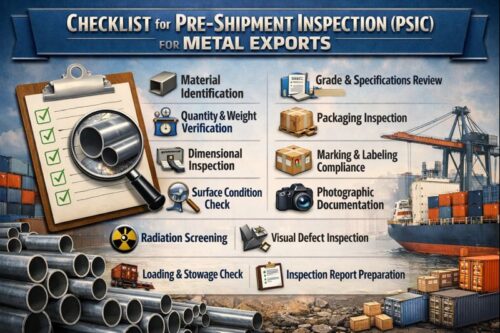
Below is a detailed checklist for PSIC designed to help exporters prepare properly, reduce friction at ports, and ensure successful international trade.
1. Verify Material Classification and Documentation
The first step is accurate identification and documentation of the material being exported. In the context of metal exports, classification mistakes can lead to rejection at the destination port.
Key checks include:
- Type of metal (e.g., ferrous, non-ferrous, alloys)
- Scrap grade standards (e.g., ISRI specifications)
- Presence of coatings or contaminants
- Source documentation confirming legal origin
- Mill test certificates (for billets, coils, sheets, etc., if applicable)
Accurate paperwork ensures transparency and faster approval during inspection.
2. Confirm Importing Country Requirements
Different countries have different rules for metal exports, especially scrap. For example:
- Some require radioactivity checks
- Others restrict hazardous contamination
- Some require specific formats for inspection photos or videos
Before scheduling a PSIC, check:
- Environmental regulations
- Allowed scrap categories
- Radiation or contamination limits
- Mandatory inspector accreditation
- Packaging standards
This prevents errors that may only surface after loading-a costly problem for exporters.
3. Engage an Approved Inspection Agency
Not all agencies are approved for all countries. A PSIC must be issued by an inspector recognized by the importing authority.
Checklist items:
- Verify agency accreditation for destination country
- Confirm availability on intended inspection dates
- Obtain a clear scope of inspection services
- Understand reporting timelines and certificate format
Popular inspection agencies operate in most major yards and ports, but confirming approvals early reduces delays.
4. Prepare Material for On-Site Inspection
Before the inspector arrives, the material should be organized and accessible. Proper preparation saves time, prevents re-inspection, and creates a smoother workflow.
Best practices include:
- Sorting metals by grade and type
- Removing hazardous or prohibited items
- Cleaning excessive dirt, oil, or waste
- Stacking or bundling for easy visual examination
- Ensuring scale and cutting equipment are functional (if needed)
For metal exports, especially scrap, inspectors look for banned components like e-waste, batteries, sealed containers, or radioactive items.
5. Conduct Radiation and Hazard Checks
Many countries mandate radiation scanning for incoming metal scrap due to historical contamination risks. During PSIC, inspectors typically:
- Scan with handheld or fixed radiation detectors
- Check for gas cylinders or sealed pressure vessels
- Inspect for explosive residues or hazardous waste
If even one contaminated piece is found, the entire shipment can be quarantined-making this checkpoint essential.

6. Loading Supervision and Photo Evidence
Once inspection is complete, most PSIC agencies supervise container loading to ensure no uninspected materials get mixed in later.
Checklist for loading includes:
- Record container number and seal number
- Photograph cargo before and after loading
- Maintain weighbridge slips
- Record packaging and dunnage materials used
Photo documentation often becomes part of the certificate for customs authorities.
7. Certificate Issuance and Documentation Handover
The final PSIC report must accurately reflect the shipment. It is a required document for customs clearance in many import-dependent markets.
Final checks:
- Validate certificate format per destination norms
- Confirm matching container and seal numbers
- Verify cargo weight and grade descriptions
- Ensure copies are sent to buyer and freight forwarder
Missing or inaccurate PSIC paperwork can stop a container at the port even if material quality is acceptable.
Conclusion
A well-managed PSIC process not only protects compliance but also enhances credibility in the global metal exports market. By following the checklist above-covering classification, regulations, preparation, inspection, loading, and certification-exporters can reduce disruptions, maintain strong buyer relationships, and ensure that each shipment arrives on time and without complications.
For updates and additional information, follow on social media platforms.