
Ultimate T Slot Nuts Weight Chart – Accurate Sizes & Easy Reference Guide
April 13, 2026
Expert Weld Square Nuts Weight Chart for Perfect Weight Accuracy
April 14, 2026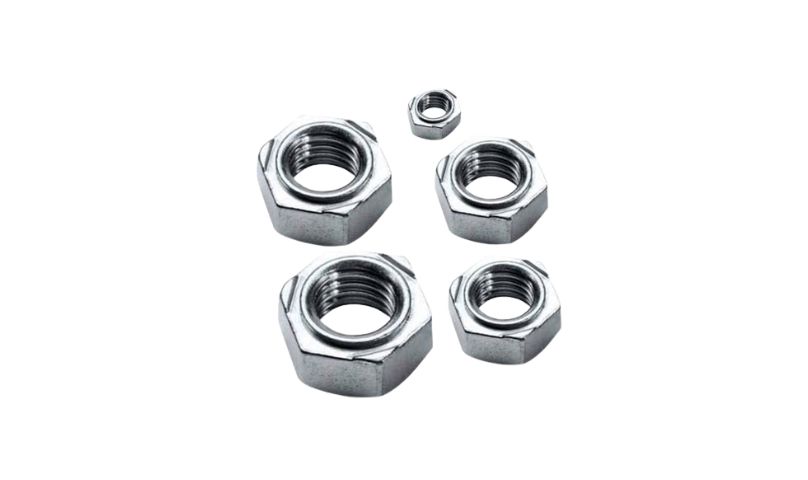
The hex weld nuts are very common fastening elements in the current manufacturing sectors, particularly in the automotive sector, sheet metal fabrication sector and the heavy engineering industry. These high-end nuts have projections that enable them to be welded permanently on the metal surface, thus forming a strong and dependable threaded bond without using other hardware such as loose nuts or tapped holes. Due to their effectiveness in mass production and capability to produce high strength joints, hex weld nuts are widely used in industrial assembly where speed, precision and durability are of utmost importance.
The knowledge of the hex weld nut weight chart, dimensions and specifications is crucial among engineers, fabricators, procurement and even workshop professionals. Weld nut weight is significant in estimating the materials, computing loads, inventory planning and controlling the cost of shipping. The slight difference in size, material grade or coating can influence the total weight which directly influences the large scale production and structural performance.
Here, in this comprehensive guide, we will discuss hex weld nut weight charts using mm and kg, DIN 929, size tables, thread specifications and calculation rules. Be it the need to pick up the appropriate weld nut to make a certain fabrication or to find the necessary information in the right format and technical information needed in industry, this guide offers all the necessary technical know-how in a simple and practical manner.
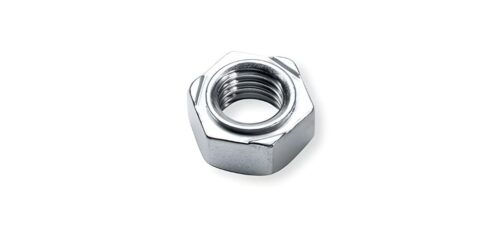
What Are Hex Weld Nuts?
Hex weld nuts are six-sided threaded fasteners with 3 or 6 welding projections that enable them to be permanently attached to metal surfaces using resistance welding.
In contrast to regular hex nuts, weld nuts do not require the use of holding tools when assembled, making it a good fit in automated production lines and high-speed production.
Key Features of Hex Weld Nuts:
- Hexagonal shape for standard tools
- Projections for strong weld bonding
- Available in DIN 929 standard
- Suitable for thin sheets and plates
- High resistance to vibration and loosening
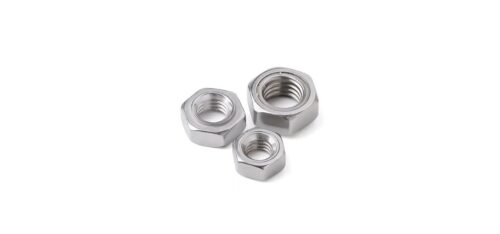
Hex Weld Nuts Weight Chart (DIN 929 – mm & kg)
Hex Weld Nuts per DIN 929 feature three welding projections (120° apart) for reliable resistance welding to metal sheets (0.5-6mm thick). Metric coarse thread, low carbon steel (min 200 MPa tensile). Weights per 1,000 pieces.
| d1 (Thread) | M | s (Width) | e (Diagonal) | h1 (Total) | h2 (Nut) | h3 (Projection) | Weight (kg/1000) | Weld Hole Ø |
| M3 | 3×0.5 | 5.5 | 5.03 | 2.4 | 2.0 | 0.4 | 0.78 | 4.3-4.5 |
| M4 | 4×0.7 | 7.0 | 6.64 | 3.2 | 2.8 | 0.4 | 1.13 | 5.7-5.9 |
| M5 | 5×0.8 | 8.0 | 7.66 | 3.7 | 3.1 | 0.6 | 1.73 | 6.6-6.8 |
| M6 | 6×1.0 | 10.0 | 9.64 | 4.4 | 3.7 | 0.7 | 2.50 | 8.3-8.5 |
| M7 | 7×1.0 | 11.0 | 10.89 | 5.4 | 4.5 | 0.9 | 3.24 | 9.3-9.5 |
| M8 | 8×1.25 | 13.0 | 12.73 | 6.2 | 5.2 | 1.0 | 5.27 | 11.3-11.5 |
| M10 | 10×1.5 | 16.0 | 15.73 | 7.6 | 6.4 | 1.2 | 9.58 | 14.3-14.5 |
| M12 | 12×1.75 | 18.0 | 17.73 | 9.2 | 7.8 | 1.4 | 13.70 | 16.5-16.7 |
| M14 | 14×2.0 | 21.0 | 20.88 | 10.5 | 8.8 | 1.7 | 21.30 | 19.0-19.2 |
| M16 | 16×2.0 | 24.0 | 23.67 | 12.1 | 10.2 | 1.9 | 28.50 | 21.7-21.9 |
Materials Available:
| Material | Grade | Key Use |
| Carbon Steel | St 37-2k | General purpose |
| Stainless | A2 (304) | Food/Marine |
| High Tensile | 8.8 | Heavy duty |
Hex Weld Nuts Dimensions (DIN 929 Standard)
Hex Weld Nuts per DIN 929 feature three welding projections (120° apart) for reliable resistance welding to metal sheets. Metric coarse thread, low carbon steel construction.
| d1 (Thread) | Pitch | s (Width across flats) | e (Width across corners) | h1 (Total height) | h2 (Nut height) | h3 (Projection height) | d2 (Weld hole Ø) | Weight (kg/1000 pcs) |
| M3 | 0.5 | 5.5 | 5.03 | 2.4 ±0.15 | 2.0 | 0.4 | 4.3-4.5 | 0.78 |
| M4 | 0.7 | 7.0 | 6.64 | 3.2 ±0.20 | 2.8 | 0.4 | 5.7-5.9 | 1.13 |
| M5 | 0.8 | 8.0 | 7.66 | 3.7 ±0.20 | 3.1 | 0.6 | 6.6-6.8 | 1.73 |
| M6 | 1.0 | 10.0 | 9.64 | 4.4 ±0.25 | 3.7 | 0.7 | 8.3-8.5 | 2.50 |
| M7 | 1.0 | 11.0 | 10.89 | 5.4 ±0.25 | 4.5 | 0.9 | 9.3-9.5 | 3.24 |
| M8 | 1.25 | 13.0 | 12.73 | 6.2 ±0.30 | 5.2 | 1.0 | 11.3-11.5 | 5.27 |
| M10 | 1.5 | 16.0 | 15.73 | 7.6 ±0.36 | 6.4 | 1.2 | 14.3-14.5 | 9.58 |
| M12 | 1.75 | 18.0 | 17.73 | 9.2 ±0.40 | 7.8 | 1.4 | 16.5-16.7 | 13.70 |
| M14 | 2.0 | 21.0 | 20.88 | 10.5 ±0.50 | 8.8 | 1.7 | 19.0-19.2 | 21.30 |
| M16 | 2.0 | 24.0 | 23.67 | 12.1 ±0.52 | 10.2 | 1.9 | 21.7-21.9 | 28.50 |
Hex Weld Nut Thread Pitch Chart (DIN 929 Standard)
Metric coarse thread is standard for DIN 929 Hex Weld Nuts. Fine threads available for M8+ sizes
| Thread Size | Coarse Pitch | Fine Pitch 1 | Fine Pitch 2 | Application Notes |
| M3 | 0.5 mm | – | – | Sheet metal <1mm |
| M4 | 0.7 mm | – | – | Automotive panels |
| M5 | 0.8 mm | – | – | Light fabrication |
| M6 | 1.0 mm | – | – | General welding |
| M7 | 1.0 mm | – | – | Medium duty |
| M8 | 1.25 mm | 1.0 mm | – | Heavy panels |
| M10 | 1.5 mm | 1.25 mm | 1.0 mm | Structural welding |
| M12 | 1.75 mm | 1.25 mm | 1.5 mm | Chassis, frames |
| M14 | 2.0 mm | 1.5 mm | – | Heavy equipment |
| M16 | 2.0 mm | 1.5 mm | – | Industrial machinery |
How to Calculate Hex Weld Nut Weight
If you don’t have a chart, you can calculate weight manually:
Formula:
Weight (kg) = Volume × Density
Where:
- Density of steel ≈ 7850 kg/m³
Simplified Approximation:
Hex weld nuts are approximated as a hex prism with a threaded hole.
Example (M8 Weld Nut):
- Approx volume = 6.8 × 10⁻⁷ m³
- Weight ≈ 6.8 × 10⁻⁷ × 7850 ≈ 0.0053 kg
This matches the standard chart value.
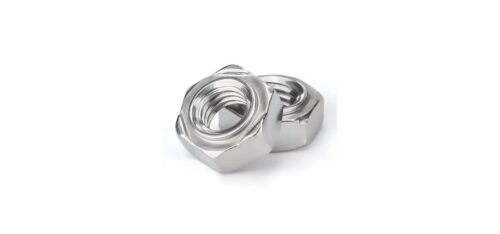
Hex Weld Nuts – Material Types & Weight Variation (DIN 929)
Weight comparison per 1,000 pieces (M8 size example) across common materials:
| Material Type | Grade/Spec | Weight (kg/1000 pcs) | Density (g/cm³) | Key Applications | Cost Factor |
| Carbon Steel | St 37-2k | 5.27 kg (Baseline) | 7.85 | General fabrication, Automotive | 1x |
| Zinc Plated CS | St 37-2k + Zn | 5.32 kg (+1%) | 7.87 | Outdoor, Corrosive | 1.2x |
| Stainless Steel | A2 (304) | 6.92 kg (+31%) | 8.00 | Food, Marine | 3x |
| Stainless Steel | A4 (316) | 6.98 kg (+32%) | 8.02 | Chemical, Saltwater | 4x |
| High Tensile | 8.8 | 5.27 kg (Same) | 7.85 | Heavy duty | 1.5x |
Weight Formula: Volume × Density
Density Impact: SS = +31% heavier than carbon steel
Projection Welding: All materials use 3-point resistance welding
Pro Tip: Use carbon steel for cost, upgrade to A2/A4 only for corrosive environments.
Common Sizes & Their Uses – Hex Weld Nuts (DIN 929)
| Size | Sheet Thickness | Primary Uses | Industry | Load Capacity | Example Applications |
| M4-M5 | 0.5-1.5 mm | Thin panels | Automotive interiors | Light duty <5kN | Dashboard, trim panels |
| M6-M8 | 1.0-3.0 mm | General fabrication | Manufacturing | Medium 10-20kN | Appliance housings, furniture |
| M10 | 2.0-4.0 mm | Structural panels | Construction | Heavy 25-35kN | HVAC ducts, enclosures |
| M12 | 3.0-5.0 mm | Chassis & frames | Heavy equipment | Very heavy 40-60kN | Tractor cabs, machinery guards |
| M14-M16 | 4.0-6.0 mm | Heavy industrial | Marine/Offshore | Extreme >70kN | Ship bulkheads, platforms |
Load ratings based on 6g thread proof load with steel backing sheet.
Most popular: M6 (35%), M8 (28%), M10 (20%) market share.
Guidelines for Using Hex Weld Nuts Weight Charts
- Always verify material type (MS / SS / Alloy)
- Consider coating weight (zinc, galvanization)
- Use standard DIN 929 values for accuracy
- Add 5–10% margin in bulk estimation
- Keep a PDF chart for site use
Conclusion
Hex weld nuts are important in any modern manufacturing as they are a quick, consistent, and resilient method of fastening a large number of industrial applications. In the automotive assemblies up to the heavy engineering structures, they are invaluable in the high volume production set-ups due to their capabilities of producing strong permanent threaded connections.The hex weld nuts weight chart, the DIN 929 dimensions, thread specifications, and material variations are critical to comprehend the correct planning and effective implementation. Whether it is to estimate the material, to calculate the load or to control the costs, accurate data of weight and size are useful to enable engineers and procurement departments to make a good decision.
With the right choice of size, material and specification depending on the needs of your application, you can guarantee maximum performance, structural integrity and long term reliability. Keeping standardized charts and following best practices will further enhance productivity and reduce errors in fabrication processes.Overall, informed decision-making and selection of hex weld nuts in assembly, as well as adherence to these selection and use, enhances efficiency in assemblies and also helps a project to be more cost-effective and of high quality.