
Step-by-Step Guide to Starting a Steel Scrap Export Business from India
January 7, 2026
Best Metal Products to Export from India in 2026: High-Demand Opportunities for Global Markets
January 9, 2026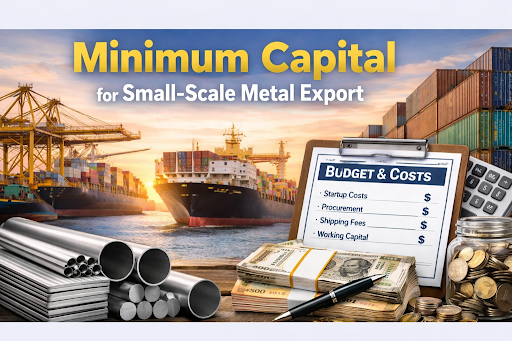
The export of small-scale metal is an appealing venture for any entrepreneur to venture into international trade without huge capital expenditure. India is also a significant producer of metals, including steel, aluminium, copper, brass, and industrial alloys, and the global demand remains high. Nonetheless, this is the most frequent query that new exporters pose: How much capital would be required to launch a small-scale metal export business? This blog disaggregates and realistically delineates the minimum capital requirement and the major cost elements.
Understanding Small-Scale Metal Export
Small-scale metal export usually entails the buying or production of small amounts of metal products or raw materials for foreign purchasers. This can be in the form of pipes, sheets, coils, fasteners, scrap or manufactured metal objects. Compared to large exporters, small-scale exporters in most cases have fewer workers, lower stocks, and target markets.
The amount of capital needed will be dependent on the type of product, order quantity, destination location and business model (trader or manufacturer). Nevertheless, metal export could be initiated with controlled investment with proper planning.
Basic Business Setup Costs
The initial capital level is the one that is used to establish the business in a legal way. This covers registration in business, opening a current bank account and some general compliance requirements. These expenses are also very cheap and may cost 10,000 to 30,000, based on the type of business.
Metal exporters must be registered for GST and issued with an Import Export Code (IEC). The IEC application fee is nominal, and GST registration is free, although professional help can cost a little.
Estimated capital required: ₹15,000 – ₹40,000
Documentation and Compliance Expenses
In the metal trade, export documentation is a repetitive issue. Such costs might be considered digital signatures, accounting software, support services with the customs documents, and compliance services. When you employ a consultant or custom broker, the cost might be different depending on the volume of shipments.
These are some of the costs required to facilitate seamless customs clearance as well as the processing of foreign remittances.
Estimated capital required: ₹20,000 – ₹50,000 annually
Product Procurement or Manufacturing Cost
This is the greatest capital element. In the case of you being a trader, you will require money to buy metal products or raw materials from domestic suppliers. In the case of the manufacturers, capital is required to acquire raw materials, labour and simple processing.
In the case of small-scale exports, most exporters begin with a one-time trial order or sample shipment. The first procurement can cost 1-5 lakh depending on the type of metal.
Estimated capital required: ₹1,00,000 – ₹5,00,000
Packaging, Testing, and Quality Control
The international customers require packaging and, in other instances, quality testing or certificates of examination. It is expensive in terms of wooden pallets, moisture-resistant wrappings, strapping, and labelling. In some metals, it might be necessary to have a third-party inspection.
These expenses are very minor in nature and are fundamental towards buyer confidence and acceptance of shipments.
Estimated capital required: ₹25,000 – ₹75,000 per shipment
Logistics and Shipping Costs
The cost of freight varies with the size of shipment, weight, country of destination and Incoterms (FOB, CIF, etc.). FOB is a common starting point for small exporters, with the buyer absorbing freight and capital is not strained as much.
Nonetheless, the exporters are still required to incur the inland transport and port handling and customs clearance expenses.
Estimated capital required: ₹50,000 – ₹2,00,000 per shipment
Working Capital and Cash Flow Buffer
Export payment is usually received after the shipment, particularly when the terms of payment include letters of credit or a credit period. Working capital helps the business to carry out its operations smoothly, pay its suppliers and take up orders.
Small-scale exporters are highly advised to have a basic cash buffer.
Recommended buffer: ₹1,00,000 – ₹3,00,000
Total Minimum Capital Estimate
For a small-scale metal export business, the minimum starting capital generally falls between:
₹3 lakhs to ₹10 lakhs, depending on product type, order size, and export model.
A small-scale metal export business does not demand a huge investment, yet it needs to be planned financially. Exporters can manage both costs and risk by starting with small quantities, adopting FOB terms and targeting honest buyers. The great manufacturing history in India and the world demand for metal products can create an opportunity to achieve international trade growth long term, even with a small investment of capital.
For updates and additional information, follow on social media platforms.