

Upcoming International Metal Trade Fairs 2026
January 2, 2026
HS codes for copper scrap and ferrous waste 2025
January 5, 2026
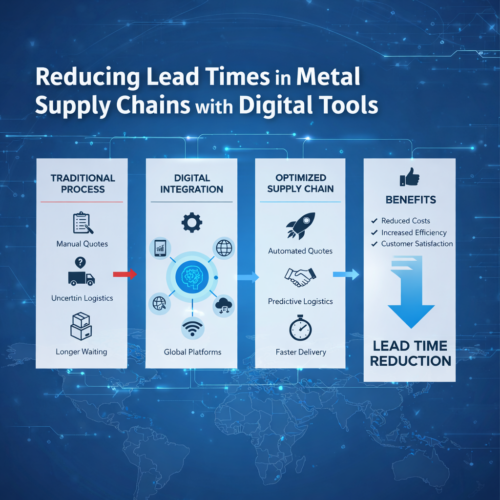
For Metal supply chain, Lead time is not merely a measurement in the metal industry; it also affects the project schedules, cash flow and customer confidence. Delays whether these delays are in the supply of raw materials to the manufacturers or the supply of finished metal products to the infrastructure projects may spread throughout the chain of value chain. Instead, metal businesses are moving towards the use of digital tools in order to minimize lead times, enhance coordination, and respond more quickly to market demand in the year 2026.
The rationale behind the continuous struggle of lead times.
Metal supply chains are complicated in nature. They encompass various processes such as sourcing, processing, storage, transportation, and deliveries which are sometimes distributed all over regions or countries. The classic work processes are based on the manual coordination, e-mail, telephone, and disjointed systems, which slow down the decision-making process and creates a bottleneck.
Common causes of long lead times include uncertainty about the demand of the buyers, slow communication with the suppliers, and inefficient procurement procedures. Digital transformation is solving such problems through providing speed, visibility, and automation at the points where it is most needed.
Quickener Demand Discovery using Digital Media.
Determination of demand and its alignment with the supply is one of the time-consuming aspects of the supply chain. Previously, suppliers used to take days or even weeks before the inquiries were transformed into serious discussions.
In the contemporary digital platforms, data and automation can be used to significantly reduce this cycle. Suppliers do not have to sit back and list products waiting to be contacted by buyers but can be actively linked with buyers whose needs are compatible with their products. This minimizes the time spent in between listing, enquiry and negotiation – the largest hidden cost of long lead times.
Automated Lead Detection and Assignment of Leads in Seconds.
Artificial Intelligence is turning out to be a decisive factor in expediting the buyer-seller relationships. Through buyer intent, previous purchasing history, and current demand indicators, AI systems are able to route leads nearly in real-time.
Social networks, such as pipex.ai, are an example of this change. Instead of distributing the leads manually or use of open markets, AI gives suppliers the relevant buyer leads in seconds. This immediacy enables suppliers to work as demand remains alive making the time lag between preliminary interest and a final order reduced.
In the case of metal business, the speed of lead assignment results in the speed of negotiation, start of production, and the predictable delivery.
Better Transparency of the Supply Chain.
End-to-end visibility is another main factor that is causing shorter lead times. Suppliers can now monitor the level of inventory, status of production and progress of shipments using digital dashboards in near real time.
Suppliers can be able to answer the questions of the buyers more confidently and not exaggerate, as they are aware of the available and where the bottlenecks can exist. Such openness will decrease the delays at the end and will assist in balancing expectations between procurement, production, and logistics teams.
Routine Processes Automation.
Digital tools are also minimizing lead times by automating routine though time intensive activities. The RFQ processing, document checking, confirmation of the order and follow-ups can now be automated and streamlined.
The businesses save on time and errors by minimizing the hand work in transactions. Particularly, this is useful in metal supply chains where a number of documents and approvals are usually needed before material can flow.
Improved partnership with logistics partners.
Another typical reason is transportation delays which contribute to longer lead times. Digital tools combining logistics information assist suppliers in planning loads with more accuracy and responding to a crisis swiftly.
Predictive analytics has the capability of identifying possible delays early enough to enable teams to make alternative route or schedule or inventory allocation proactively. The traditional and siloed systems had a hard time reaching such a level of coordination.

The Competitiveness of Fastness.
As of 2026, minimizing lead times has ceased to be merely an operational efficiency issue, but a competitive point of difference. Customers are becoming more willing to work with suppliers who are fast, responsive, communicative and reliable.
The digital platforms are enabling metal businesses to condense timelines throughout the supply chain by integrating AI-based lead assignment, real-time visibility, and automated workflows. The outcome is expedited deal closure, easier execution and improved customer relationships.
With the current industry developing more dynamically, companies investing in the appropriate digital tools are in the best position to go at the pace currently required in the industry.
For more inforational insights, follow us on LinkedIn, Instagram, Facebook, Pinterest.