

How to Secure Payment in International Metal Trade
January 6, 2026
Calculating FOB vs CIF Prices for Metal Exports
January 7, 2026
To export metal products to foreign markets, it is necessary to plan the export and document it correctly. The customs officials in each country have very rigid rules in case they want to make sure that goods are exported legally, valued properly and in a safe way. Absence of documents or their wrong formats may lead to delays during shipment, fines or refusal by ports. This blog describes the documents that are required in the metal export customs clearance and it is a way to make the exporters know what they are required to have and the purpose of each document.
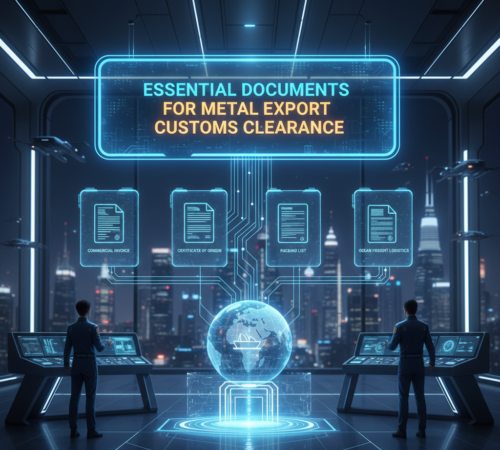
Why Documentation Is Important in Metal Exports
Goods of high value include metal i.e. steel, aluminum, copper and alloys. Governments are very attentive to these exports to control quality, taxation and observance of trade laws. Due documentation assists the customs authorities to check the details of shipment and clearance is easily carried out at ports.
Correct documents ensure:
- Faster customs approval
- Calculation of duty and taxes correctly.
- Adherence to export laws.
- Confidence among the exporter, buyer, and the authorities.
- Commercial Invoice
Commercial invoice
One of the most significant documents in the metal export customs clearance is the commercial invoice. The exporter issues it and gives all the information about the shipment.
Key details included:
- Information of the exporters and importers.
- Metal products description.
- Weight, unit price, and quantity.
- Total shipment value
- Payment terms and currency
This document is used by the customs authorities to determine the value of goods and determine export duties where necessary.
Packing List
A packing list provides information in detail about the way the metal products are packed. It assists customs agents and logistics companies to check and manage the shipment in the right way.
The packing list includes:
- Number of packages
- Net and gross weight
- Type of packaging
- Product dimensions
- Markings and labels
In the case of metal exports, the weight specifications are important, since metals are heavy and freight expenses will rely on the weights.
Export Declaration or Shipping Bill.
Shipping bill is a compulsory custom document submitted by the exporter or the custom broker. It serves as the principal export statement to the custom authorities.
This document contains:
- HS code of metal products
- Export value
- Destination country
- Port of loading
- Export incentives (where applicable)
- Metal goods cannot be exported without a shipping bill that has not been approved.
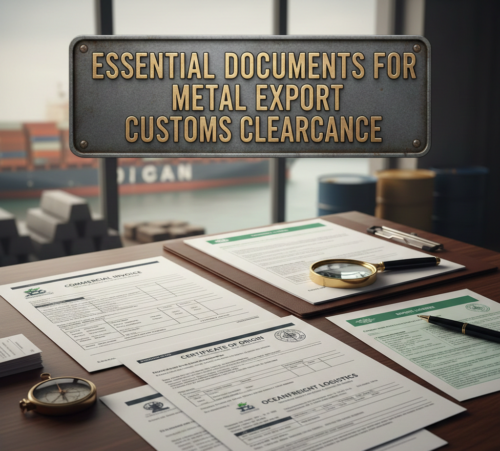
Bill of Lading or Airway Bill
The carrier issues the bill of lading (where the shipment is sea) or the airway bill (where the shipment is air based). It is an evidence of shipment and contract of carriage.
It includes:
- Shipper and consignee name.
- Description of goods
- Shipping route
- Freight details
- Banks also require this document in the processing of payment on Letters of Credits.
Certificate of Origin
The certificate of origin verifies the country in which the metal products are processed or made. Most of the importing nations need this document to impose the right import duties or trade benefits.
Benefits of this document:
- Campaign as a trade agreement partner.
- Reduced customs duty
- Reduced time in destination in-port clearance.
- It is normally granted by licensed chambers of commerce.
Quality Certificates and Inspection.
Metal buyers usually insist on inspection certificates that will ensure product quality and specifications. These certificates can be provided by third party inspection agencies.
The common ones are:
- Mill test certificate
- Chemical composition report.
- Mechanical test report
- Pre-shipment inspection certificate.
- These documents enhance confidence of the buyers and minimize conflicts.
Export License or Regulatory Approval.
Due to the regulations of a government some metal products should be exported with a license or special approval. This is mostly applied to restricted metals, scrap materials or alloys involving defense.
Exporters must check:
- Export control regulations that are specific to the country.
- Environmental regulations
- Scrap export policies
- Scheduling of shipments may be seized in case the necessary approvals are not obtained.
- Insurance Certificate
An insurance certificate will be a document showing that the metal will be insured in case of damage or loss in transit. It insures both seller and purchaser, particularly in the case of high value goods.
Such a document is customary in the conditions of CIF or CIP shipping.
Conclusion
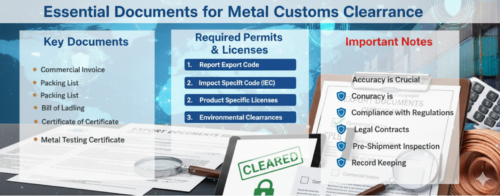
Effective metal export customs clearance is based on proper documentation. The commercial invoice, packing list, shipping bill, bill of lading, certificate of origin, and inspection certificates are the documents that are used in order to make sure that the customs regulations are adhered to. The metal exporters are able to circumvent delays, minimize risks, and preserve good relations with international trade partners by ensuring that the export documents are properly and fully prepared.
For updates and additional information, follow on social media platforms.