
Complete Buttweld Reducer Eccentric Weight Chart Guide: Dimensions, Weight in KG & MM
February 13, 2026
Buttweld U Bend Weight Chart – Complete Dimensional and Load Reference for Industrial Systems
February 14, 2026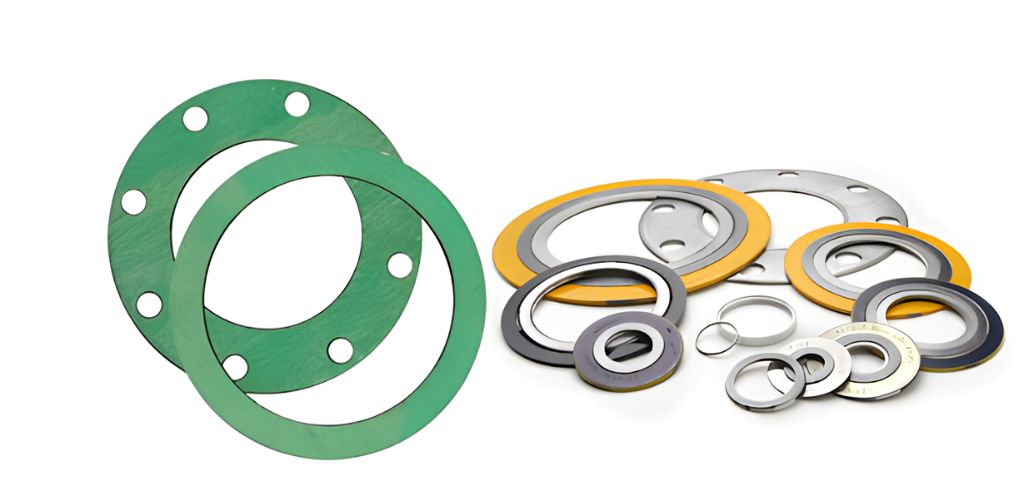
Gaskets play a critical role in industrial piping systems by creating a reliable seal between two mating surfaces. Whether used in oil & gas pipelines, chemical plants, power generation units, or water treatment facilities, selecting the correct gasket size and thickness is essential for leak-free performance. One often overlooked but important factor in gasket selection is gasket weight, which directly depends on its size, thickness, and material density. This article explains gasket weight in detail, including size and thickness charts in kilograms and millimeters, along with practical calculation examples.
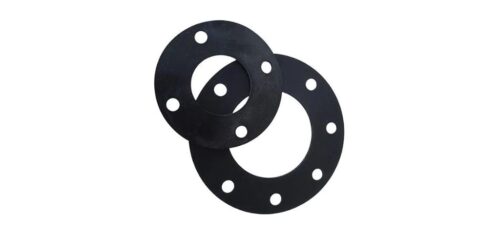
Why Gasket Weight Matters
Understanding the gasket weight chart is important for several reasons. In large piping projects, even small variations in gasket weight can affect overall load calculations, transportation costs, and inventory planning. For high-pressure flange joints, the weight of metallic gaskets such as spiral wound or ring-type joints also impacts bolt load distribution and sealing efficiency. Engineers and procurement teams rely on accurate gasket weight data to ensure proper installation and long-term reliability.
Factors Affecting Gasket Weight
Gasket weight is influenced by multiple parameters:
- Material Density: Materials like stainless steel, graphite, PTFE, and soft rubber have different densities, significantly affecting final weight.
- Gasket Type: Spiral wound, RTJ, and full-face gaskets have different constructions, which impact weight even with similar dimensions.
- Outer Diameter (OD): Larger outer diameters increase material volume and weight.
- Inner Diameter (ID): A smaller inner diameter means more material, resulting in higher weight.
- Thickness: Thicker gaskets weigh more due to increased material volume.
Industrial Gasket Sizes (Standard Availability)
| Gasket Material / Type | Standard Size Range |
| Rubber Gaskets (NBR / EPDM / Neoprene) | ½” to 60″ |
| CNAF / CAF Sheet Gaskets | ½” to 48″ |
| PTFE Gaskets | ½” to 72″ |
| Expanded PTFE (ePTFE) Gaskets | ½” to 80″ |
| Graphite Sheet Gaskets | ½” to 72″ |
| Spiral Wound Gaskets | ½” to 60″ |
| Ring Type Joint (RTJ) Gaskets | ½” to 36″ |
| Metal Jacketed Gaskets | ½” to 48″ |
| Camprofile Gaskets | ½” to 60″ |
| Corrugated Metal Gaskets | ½” to 48″ |
| Full Face Gaskets (ASME / DIN) | ½” to 48″ |
| Flat Ring Gaskets | ½” to 72″ |
| Soft Cut Gaskets (Non-Asbestos) | ½” to 60″ |
| Copper / Aluminium / SS Metal Gaskets | ½” to 36″ |
| Custom Cut Gaskets (CNC / Waterjet) | Up to 120″ |
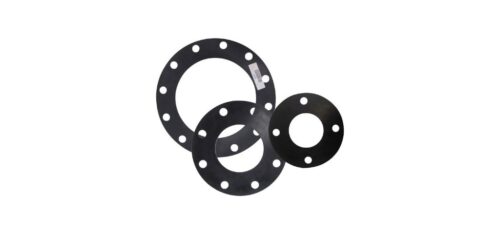
Gasket Size & Thickness Chart
Below is an indicative gasket weight chart showing approximate weights for flat metallic gaskets. Actual values may vary depending on material grade and manufacturing tolerance.
| Gasket Size (NB) | OD (mm) | ID (mm) | Thickness (mm) | Approx. Weight (Kg) |
| 25 NB | 85 | 35 | 3 | 0.18 |
| 50 NB | 125 | 60 | 3 | 0.32 |
| 80 NB | 160 | 90 | 3 | 0.48 |
| 100 NB | 190 | 115 | 3 | 0.65 |
| 150 NB | 250 | 170 | 3 | 1.10 |
For thicker gaskets, weight increases proportionally. For example, a 6 mm thick gasket will weigh approximately double that of a 3 mm thick gasket, assuming the same material.
Gasket Weight Calculation Formula
To calculate gasket weight accurately, the following formula is commonly used:
Gasket Weight (Kg) = Volume × Material Density
Where:
- Volume = π × (OD² − ID²) / 4 × Thickness
- OD, ID, and thickness are in meters
- Density is in kg/m³
Example Calculation
Consider a stainless steel gasket with:
- OD = 190 mm
- ID = 115 mm
- Thickness = 3 mm
- Density of stainless steel ≈ 8000 kg/m³
Weight Differences by Gasket Type
- Spiral Wound Gaskets: Heavier due to metal windings and filler materials; commonly used in high-pressure applications.
- Ring Type Joint (RTJ) Gaskets: Solid metal construction results in higher weight compared to flat gaskets.
- Soft Gaskets (PTFE, Rubber, CNAF): Lightweight and ideal for low-pressure or corrosive environments.
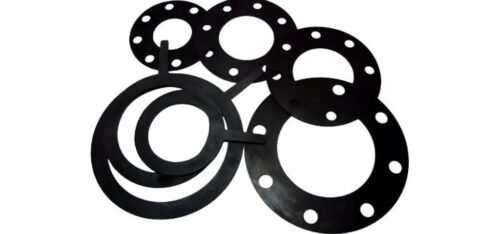
Gasket Dimensional Tolerances
Thickness & Diameter-Based Tolerances (mm)
| Gasket Size Range (mm) | Thickness Tolerance | Inside Diameter (ID) Tolerance | Outside Diameter (OD) Tolerance |
| ≤ 50 | ±0.20 | ±0.50 | ±0.80 |
| >50 ≤ 100 | ±0.25 | ±0.70 | ±1.00 |
| >100 ≤ 200 | ±0.30 | ±1.00 | ±1.50 |
| >200 ≤ 300 | ±0.35 | ±1.20 | ±2.00 |
| >300 ≤ 450 | ±0.40 | ±1.50 | ±2.50 |
| >450 ≤ 600 | ±0.45 | ±2.00 | ±3.00 |
| >600 ≤ 800 | ±0.50 | ±2.50 | ±3.50 |
| >800 ≤ 1000 | ±0.60 | ±3.00 | ±4.00 |
| >1000 ≤ 1500 | ±0.70 | ±3.50 | ±5.00 |
| >1500 | ±0.80 | ±4.00 | ±6.00 |
Practical Applications in Industry
Knowing gasket weight helps in flange load calculations, crane handling for large diameter joints, and optimizing logistics for bulk orders. EPC contractors, maintenance teams, and OEMs rely on accurate gasket weight charts during design and procurement stages.
Conclusion
Understanding gasket weight through size and thickness charts in kilograms and millimeters ensures better engineering decisions and cost efficiency. By considering dimensions, material density, and gasket type, industries can select the right gasket for performance, safety, and long-term durability. Using standard charts along with basic weight calculation formulas simplifies planning and reduces the risk of sealing failures in critical applications.