Calculating FOB vs CIF Prices for Metal Exports
January 7, 2026
Minimum Capital Required for Small-Scale Metal Export: A Practical Guide for New Exporters
January 8, 2026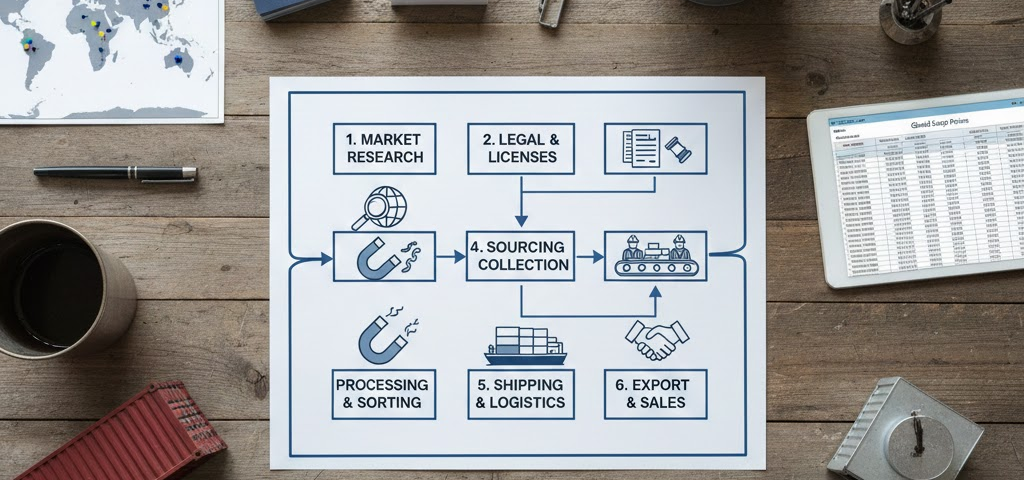
Sustainability and recycling of steel have also gained a lot of momentum worldwide, and the need for recycled steel has risen a lot. Steel scrap is a good raw material for steel manufacturers all over the world; hence, steel scrap export is a good business prospect for Indian entrepreneurs. This discipline, however, requires proper planning, compliance with regulations, and familiarity with international trade practices to succeed. This tutorial demonstrates how one can easily and realistically get a Steel Scrap Export Business from India going step-by-step. As the demand for steel scrap continues to grow, establishing a Steel Scrap Export Business from India can be a lucrative venture.
Understanding the Steel Scrap Export Market
In this competitive landscape, understanding the nuances of operating a Steel Scrap Export Business from India is essential for success.
Why Start a Steel Scrap Export Business from India?
With the growing global emphasis on sustainability, a Steel Scrap Export Business from India positions you strategically in the international market.
Before entering the business, it is important to understand the steel scrap market. Steel scrap includes materials such as heavy melting scrap (HMS), shredded scrap, turnings, and industrial offcuts. Different countries have different quality standards, contamination limits, and import regulations. The quality standards, contamination limits, and import regulations in different countries vary. Market research will enable you to determine the areas that are in demand, price wars, and scrap grades, which will enable you to position your Steel Scrap Export Business from India favorably.
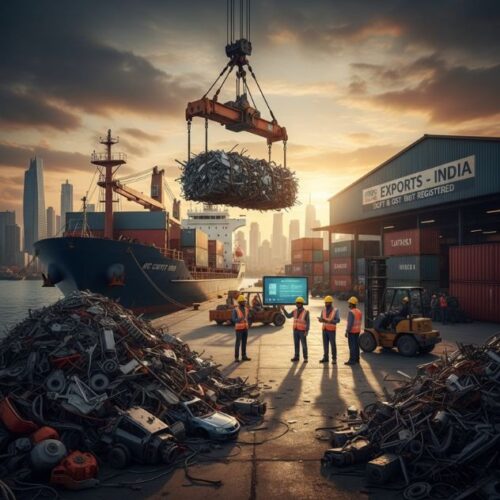
Step 1: Register Your Business
The first one is to register a business legally. You may be a sole proprietorship, a partnership company, an LLP, or a private limited company. The type of structure you have taken must be in line with your investment power and expansion strategies. After registration, open a current bank account in the business name, since these will be needed to make export transactions and documents.
Step 2: Obtain an Import Export Code (IEC)
The exportation of steel scrap in India requires an Import Export Code (IEC). The IEC is a 10-digit unique identification number that is issued by the Directorate General of Foreign Trade (DGFT). The application is entirely online and involves simple documents like PAN, address proof, and bank details. In the absence of the IEC, international payments and customs clearance cannot be done.
Step 3: Complete GST and Other Registrations
Exporters must also be registered under the GST because this makes it possible to pay the taxes and claim the refunds. In addition, Udyam (MSME) registration and ICEGATE registration on customs filing may also be required, depending on your operations. In case you are dealing with scrap processing or storage, the local authorities or pollution control boards may approve you.
Step 4: Source and Grade Steel Scrap
The quality of steel scrap sourcing is an important aspect of business. Scrap is either sourced as part of manufacturing plants, demolition, industrial waste providers or shipbreaking. It needs to be properly segregated, cut and graded to meet export specifications. Knowing that scrap must be without dangerous substances, radiation and too much rust, quality control is quite crucial in many importing countries.
Step 5: Understand Export Regulations and Documentation
The export of steel scrap in India has to be in accordance with the Foreign Trade Policy and customs. The proper identification of the HS code is necessary to calculate and document the duty properly. Normative export documents consist of a commercial invoice, packing list, bill of lading, certificate of origin and inspection certificates when necessary. The knowledge of these requirements will prevent delays and fines in shipment.
Step 6: Find Overseas Buyers
The international purchasers are available in B2B marketplaces, trade fairs, export promotion councils, and industry associations. Clear product specifications, quantities, prices, terms of payment, and delivery conditions should be agreed upon before final deals. Financial risk is minimised through secure methods of payment like letters of credit or advance payments, particularly when a new exporter is involved.
Step 7: Arrange Logistics and Shipping
A big part of steel scrap export involves logistics planning. Select good freight forwarders and shipping lines that have dealt with bulk or containerised scrap cargo. Make sure that containers are properly stuffed, the weight is met, and the ports are documented. Early coordination with customs brokers assists in making sure that clearance and shipment are done smoothly.
Step 8: Receive Payment and Maintain Compliance
Foreign payments are received by authorised banks after shipment. It is necessary to keep proper records of export transactions, invoices, and remittances to facilitate audits and compliance. Periodically change your IEC and GST returns, and make sure that you do not disrupt your export business.
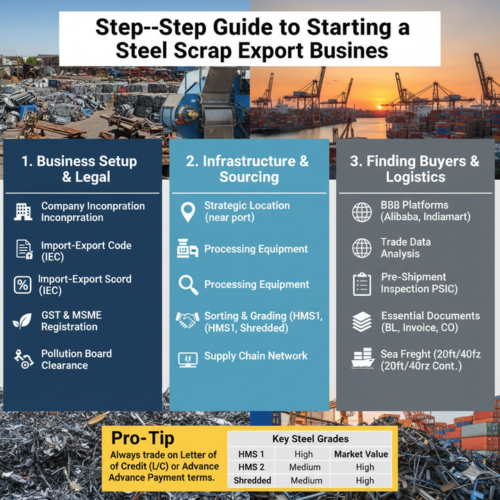
A steel scrap export business needs a systematic strategy, which involves business registration, IEC permission, sourcing, finding buyers and logistics management. As the world grows increasingly dependent on recycled steel, high-quality, compliant, and dependable partnerships can help exporters create a profitable and sustainable business. With this step-by-step guide, you can be assured of going into the steel scrap export business and venturing into foreign trade.